Healthcare Operations
Cerevia 🏆
“Catch physician coverage gaps before they reach a stroke patient.”
Teleneurology coverage command center that rebuilds physician and consult state from 1,160+ raw telemetry events, forecasts coverage gaps 90+ minutes ahead, and runs an explainable 8-rule off-shift offer loop with human approval and ElevenLabs voice notification. 🏆 1st Place, Sevaro Track, Rutgers Health Hack 2026.
Anish Shirodkar · Rishabh Shah · Joy Shah · Chandan Bhopi · Hitanshu Oza · Krish Gopani
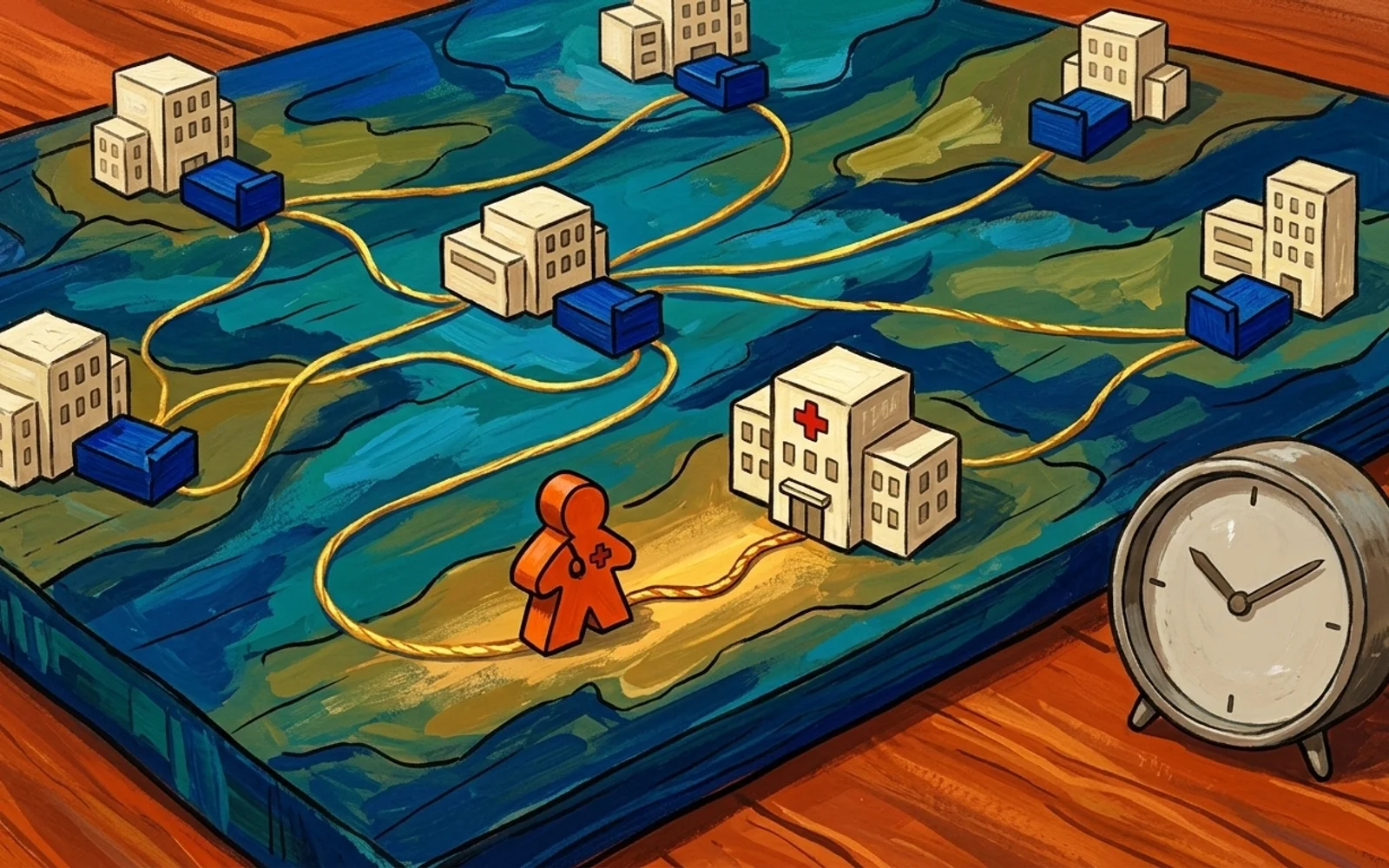
The Problem
Sevaro's neurologists cover 200+ hospitals remotely by phone and video. Stroke consults are the most urgent, and minutes matter. Today, calls are routed automatically and a live screen shows each doctor's status. When a rush hits, it's up to a person to notice, work out by hand who could help, and phone them. That breaks down on busy shifts, especially when a hospital surges just as doctors are ending their shifts.
The Challenge
Build a tool that detects problems now and in the next 90 minutes, decides on the right fix and who approves it, and acts on it, with a person approving every offer to an off-duty doctor. The final test was a new events file the judges dropped in live, which the tool had to absorb without a restart.
What it does
- Rebuilds the real picture from raw event data: replays ~1,160 events in true chronological order, handling late records, deduplicating calls, and preserving patient wait times.
- Works out who is actually free: combines Synapse call and video state, camera signals, and desktop helper heartbeat rather than trusting self-reported statuses.
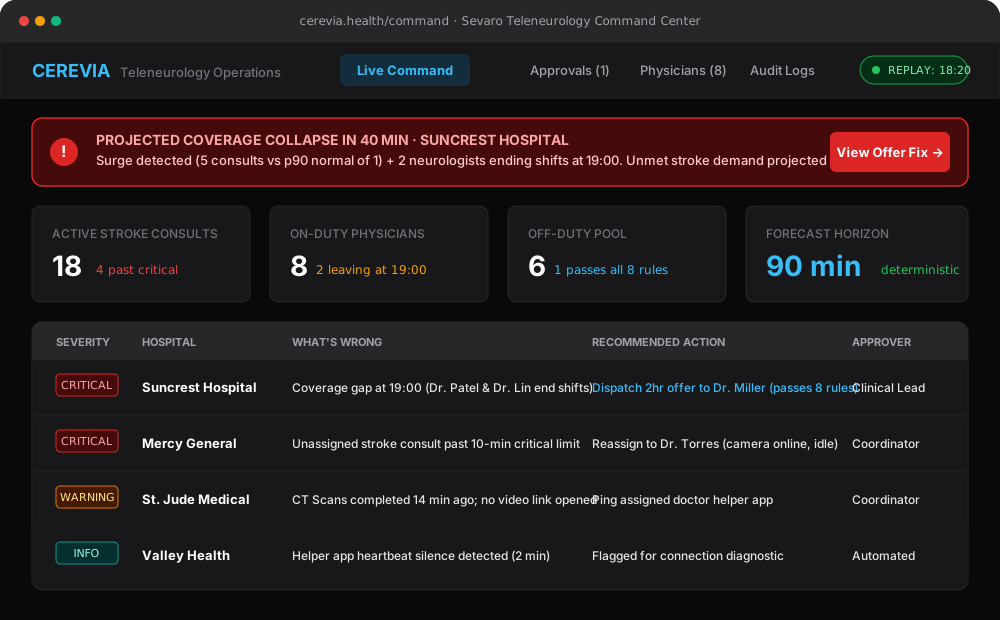
- Tracks every consult against critical time limits: unassigned stroke consults, scans back with no video started, and unfinished notes near shift end.
- Ranks what needs attention: answers what's wrong, where, why it matters, and what to do, including who approves and why that fix beats alternatives.
- Forecasts 90+ minutes ahead: compares hospital volume against its normal busy baseline (p90) to detect surges and project coverage through upcoming shift ends.
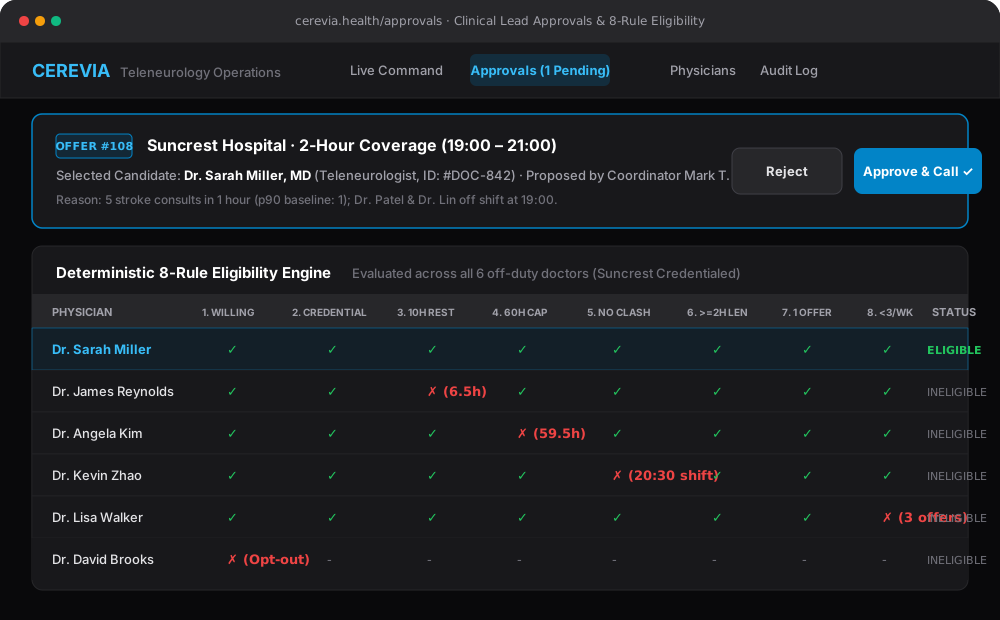
- Finds eligible off-duty doctors via 8 strict rules: willing, credentialed, 10h rest, 60h weekly cap, no shift clash, ≥2h duration, 1 open offer cap, and <3 weekly offers.
- Prevents doctor swamping: limits incoming doctors to the short hospital and equalizes starting consult counts with peers.
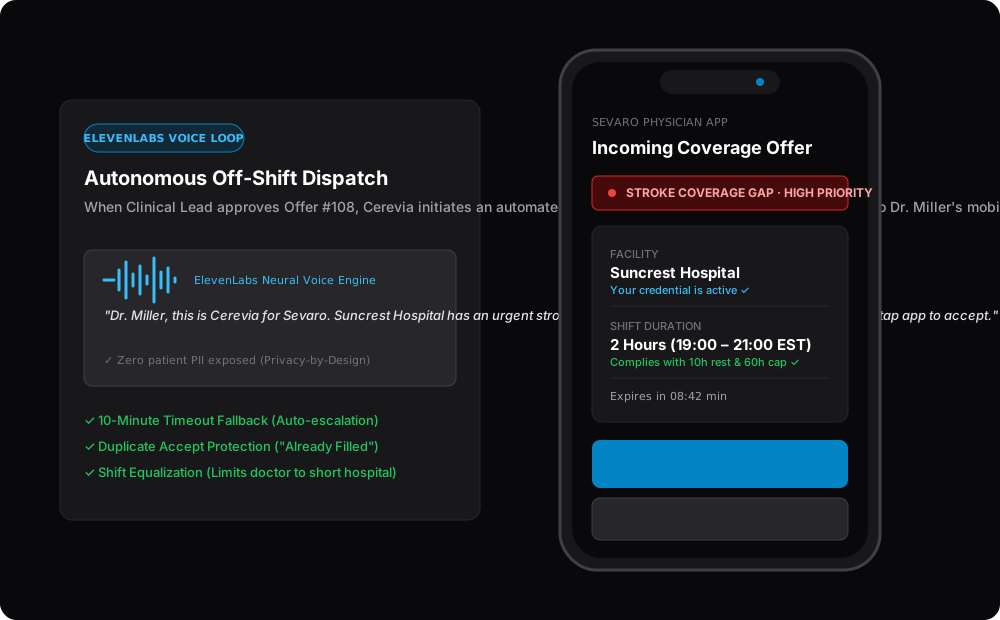
- Runs the full human-in-the-loop offer loop: coordinator proposes, clinical lead approves, and ElevenLabs voice-notifies the doctor's phone for 1-tap accept/decline.
- Keeps an auditable deterministic log: traces every recommendation to raw data and rules with zero AI hallucinations in staffing decisions.
- Absorbs new data live: takes live judge event drops with zero restart.
Key Design & Architectural Decisions
- No AI makes staffing decisions: all logic is deterministic, explainable, and fully auditable. Every recommendation traces back to data and rules.
- A person stays in charge: automated alerts only; moving consults, escalating, or contacting doctors requires explicit human approval.
- Privacy by design: offers contain only hospital, hours, and reason—never patient details.
- One role, one job: coordinators triage, clinical leads approve in 1 click, and doctors simply accept or decline.
- Calm interface: warm neutral palette, single accent color, and type hierarchy rather than stressful flashing alarms.
Results & Verification
- Rebuilt the 6:20pm picture to match the reference snapshot: 8 doctors and 18 open consults.
- Caught 4 stroke consults past their critical limits.
- Found the Suncrest surge (5 consults in an hour vs. 1 normal baseline) with 2 doctors leaving at 19:00.
- Of 6 off-duty doctors, accurately identified the only 1 who passed all 8 rules.
Demo Screens & System Walkthrough
Built with
- Next.js
- React
- TypeScript
- Tailwind CSS
- FastAPI
- Python
- Flutter
- ElevenLabs
- Vercel